






Gulf & Middle East
Oman, Bahrain and Türkiye apostille at home. Papers from the UAE, Qatar, Kuwait, Jordan and Egypt are legalised through the Saudi embassy or consulate instead.

Documents · Apostille and attestation
Most delays we see in a Saudi formation start with one document in the wrong form: an old extract, a missing notary stamp, a name spelled two ways. We give you the exact list for your structure, the route each paper takes in the country that issued it, and a checked Arabic translation at the end.
Written by the formation desk at Saudia Company Formation, Lahore. Checked on 15 October 2026: membership dates against the HCCH status table (last updated 30 June 2026), bank acceptance against SAMA’s circulars of 6 April and 24 October 2023, and in-Kingdom authentication against the Saudi Ministry of Foreign Affairs ratification service.
Reply within one working day
Every countryApostille or embassy route
One setFor MISA, CR and bank
Since 7 Dec 2022Saudi Arabia accepts apostilles
Checked firstBefore anything is stamped
The rule
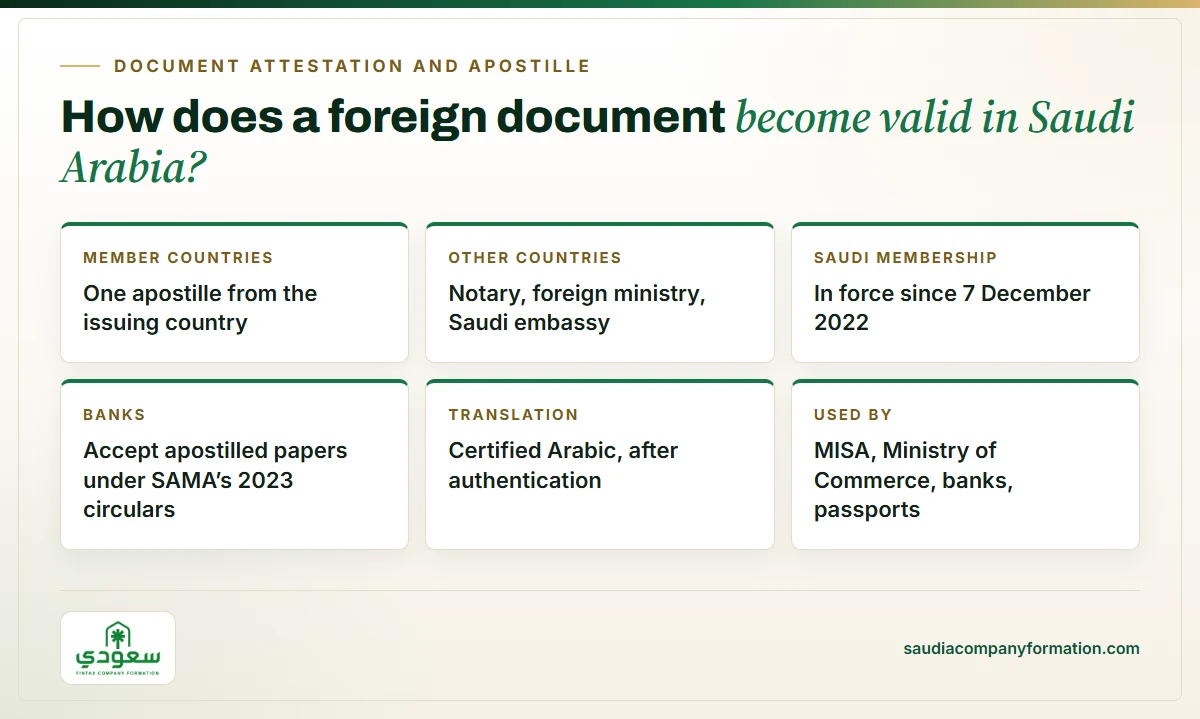
A document issued abroad becomes valid in Saudi Arabia once the issuing country authenticates it: by a single apostille if that country is in the Hague Apostille Convention, or by a chain of legalisation ending at the Saudi embassy if it isn’t. It is then translated into Arabic for filing.
Saudi Arabia joined the Convention with effect from 7 December 2022. Since then, papers from member countries skip the embassy altogether. MISA’s Investor Guide (13th edition, 2026) still asks for the foreign CR and financial statements “certified by the Saudi Embassy”, plus the parent company’s CR when its nationality differs; for a public document from a member country, the apostille fills that role.
By region
The country that issued the document decides the route, not the country you live in. A UK extract follows the UK route even if you live in Dubai. For papers issued in Pakistan, India or Bangladesh, our country pages name the offices and the order.
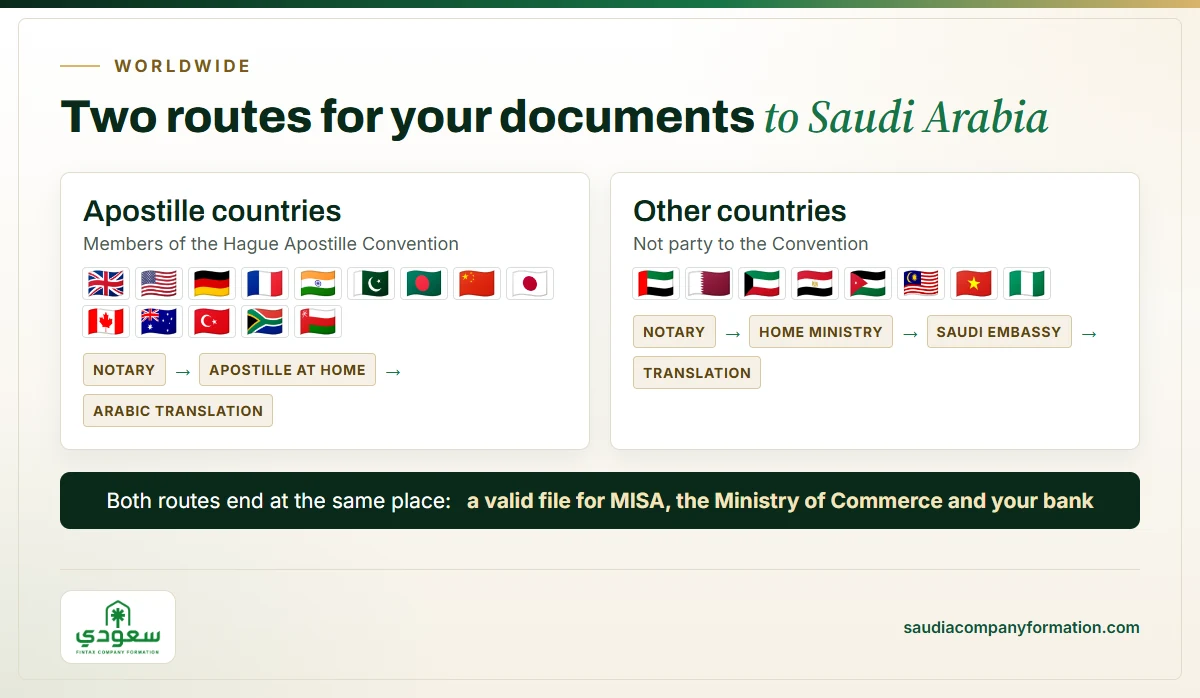
Oman, Bahrain and Türkiye apostille at home. Papers from the UAE, Qatar, Kuwait, Jordan and Egypt are legalised through the Saudi embassy or consulate instead.

India, Pakistan and Bangladesh are Apostille members, so company papers are apostilled at home. For Sri Lanka and Nepal we confirm the route before anything is stamped.

Company registry extracts, resolutions and passports are notarised where needed and apostilled by the home authority. No embassy visit.

US papers are apostilled by the state (or federal) authority, and Canada has used the apostille since January 2024. Australia, New Zealand, Mexico and Brazil apostille too.

China (since November 2023), Japan, South Korea, Singapore, Indonesia and the Philippines apostille. Vietnam has used the apostille since 11 September 2026; Malaysian papers still go through Saudi consular legalisation.

South Africa and Morocco apostille. For Nigeria, Kenya, Ghana, Ethiopia and other countries we check the current status and use embassy legalisation where it is still required.
Membership changes: Vietnam joined with effect from 11 September 2026, so its papers no longer need the Saudi embassy. We check the HCCH status table for your country before anything is stamped.
Two routes
An apostille is one certificate from the issuing country, while embassy attestation is a chain of stamps that ends at the Saudi embassy. People call both “attestation”, but they take different time and different steps.
Swipe to compare →
| Question | Apostille | Embassy legalisation |
|---|---|---|
| When it applies | Issuing country is an Apostille Convention member | Issuing country is not a member |
| Steps | Notary if needed, then one apostille | Notary, foreign ministry, sometimes chamber, then Saudi embassy |
| Saudi embassy involved | No | Yes |
| How it is verified | Online register or QR code | Stamps on the document |
| Next step | Certified Arabic translation | Certified Arabic translation |
Never pay for both. An apostilled document from a member country doesn’t also go to the Saudi embassy. We confirm the route per document so you pay only for the steps it needs.
Reference table
Eight documents make up most Saudi formation and residency files, and each takes a set route: an apostille from member countries, or a notary, foreign ministry and Saudi embassy chain from the rest. We confirm your exact steps for the issuing country before you start.
Swipe to see the full table →
| Document | Who issues it | From an apostille country | From a non-member country | Watch for |
|---|---|---|---|---|
| Certificate of incorporation or registry extract | Company registry | Certified copy, then apostille | Certified copy, foreign ministry, Saudi embassy | Issued within three months |
| Articles or constitution | Company registry or notary | Certified copy, then apostille | Certified copy, foreign ministry, Saudi embassy | Latest amended version |
| Financial statements | Auditor | Notarised or certified, then apostille | Certified, sometimes chamber, foreign ministry, embassy | Last fiscal year |
| Board resolution | Your company | Notarised, then apostille | Notarised, foreign ministry, embassy | Names match passports exactly |
| Power of attorney | You, before a notary | Notarised, then apostille | Notarised, foreign ministry, embassy | Scope limited to the steps needed |
| Passport copy | Notary or lawyer | Certified copy, then apostille | Certified copy, foreign ministry, embassy | Six months’ validity |
| Degree certificate | University | Apostille, often after verification | Foreign ministry, embassy | Needed for some work visas |
| Marriage and birth certificates | Civil registry | Apostille | Foreign ministry, embassy | For family residency |
Commercial papers such as invoices and certificates of origin usually need a chamber of commerce stamp first, even on some apostille routes. India’s Ministry of External Affairs, for example, authenticates a commercial document on the strength of the chamber’s signature, so the chamber step comes before it.
Our method
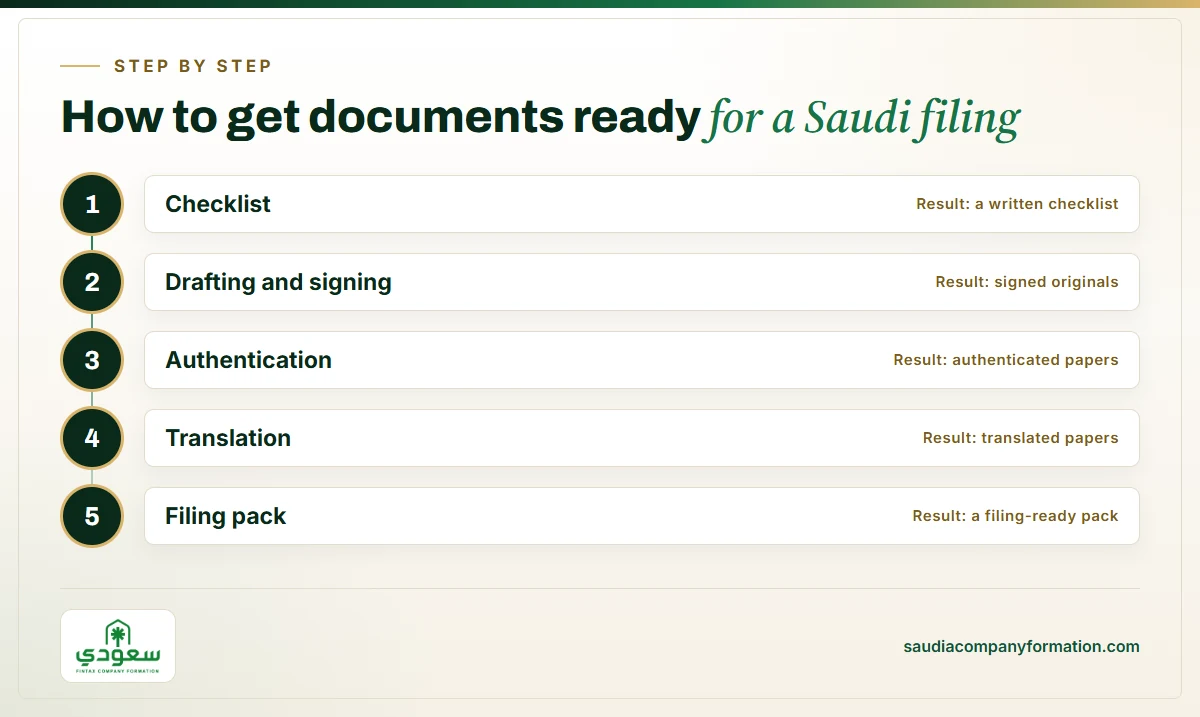
Preparing documents for a Saudi filing takes five steps, from a written checklist to an indexed filing pack. The checklist comes first so you pay for no stamp your structure doesn’t need.
The documents your structure needs, and the exact form of each, for the country that issues it.
Result: a written checklist
Resolutions, powers of attorney and declarations drafted and signed before a notary.
Result: signed originals
Apostille in member countries, legalisation ending at the Saudi embassy elsewhere.
Result: authenticated papers
Certified Arabic translation, with each name and date checked against the passport and the original.
Result: translated papers
One indexed set with certified copies for each authority and the bank.
Result: a filing-ready pack
Typical files
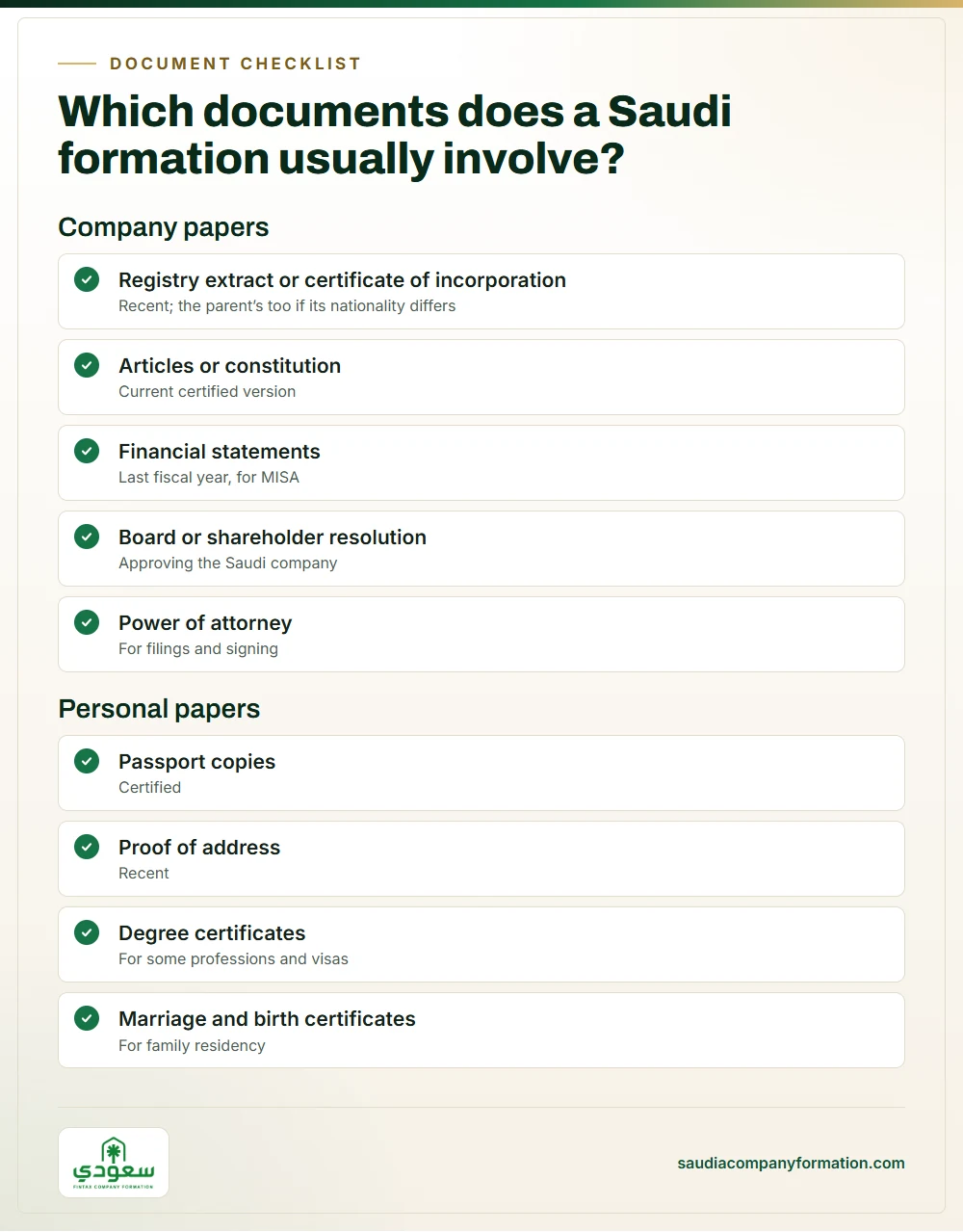
A typical Saudi formation involves five company papers and four personal ones, starting with a recent registry extract. If nobody needs a work visa or family residency, the degree and family certificates drop off the list.
Registry extract or certificate of incorporationRecent; the parent’s too if its nationality differs
Articles or constitutionCurrent certified version
Financial statementsLast fiscal year, for MISA
Board or shareholder resolutionApproving the Saudi company
Power of attorneyFor filings and signing
Passport copiesCertified
Proof of addressRecent
Degree certificatesFor some professions and visas
Marriage and birth certificatesFor family residency
Ways to use us
We prepare documents for Saudi Arabia in three ways: the full formation pack, single papers authenticated by the right route, or a power of attorney so you don’t have to travel. Most clients take the full pack alongside the rest of their Saudi company formation services.
Everything
Every shareholder and manager document for MISA, the CR and the bank, prepared once.
For investors forming a Saudi company.
Quote the packAuthentication
Specific documents authenticated by the right route for their issuing country.
For individual papers.
Quote authenticationAuthority
Drafted for the exact steps, signed, authenticated abroad and translated.
For investors who won’t travel.
Quote a POAFees
The cost of authenticating documents for Saudi Arabia depends on the issuing country and on how many papers need the full embassy chain rather than a single apostille. Each country’s notaries and ministries set and change their own fees, so we list them separately in your quote, next to our fixed fee for the agreed scope.
Document questions · 50
Checked against the HCCH status table and SAMA’s 2023 circulars. The rest comes from our own filing practice.
Authenticating a foreign document so Saudi authorities accept it, by apostille or embassy legalisation, usually followed by Arabic translation.
A certificate from a Hague Apostille Convention member confirming that a public document’s signature, seal or stamp is genuine, so other members accept it without legalisation.
Yes, since the Convention entered into force for Saudi Arabia on 7 December 2022.
Loosely, yes. Legalisation usually means the embassy chain; attestation is often used for any authentication.
MISA and the Ministry of Commerce for formation, banks for the account, the passports directorate for residency, plus courts and notaries.
Not for use inside Saudi Arabia. For use abroad, the Saudi Ministry of Foreign Affairs issues the apostille, and its ratification portal can verify one.
A plain photocopy can’t. A certified copy made by a notary or the issuing body can.
A few days for an e-apostille; several weeks for a full embassy chain.
We plan and coordinate the route for any country, working with notaries and offices there. For Pakistani shareholders, our guide to forming a Saudi company from Pakistan shows where the documents fit.
Convention members, including the UK, the US, most of Europe, India, Pakistan, Bangladesh, China, Japan and Canada. The HCCH table lists them all.
An authority each country designates, often its foreign ministry or a court.
From members for which the Convention is in force with Saudi Arabia. We check the pair before anything is stamped.
No. The apostille replaces that step.
Yes. SAMA’s circular of 6 April 2023 tells banks an apostilled document needs no further stamp from MOFA or an embassy. Some banks kept refusing them, so SAMA repeated the instruction on 24 October 2023 (circular No. 2310250731).
Many carry a QR code or register number the issuing authority can check.
An apostille issued electronically. Bangladesh is one of the countries that issues them online.
A resolution is a private document. Notarising makes it a public document that can then be apostilled.
The Convention entered into force for India on 14 July 2005, for Pakistan on 9 March 2023 and for Bangladesh on 30 March 2025.
China’s membership took effect on 7 November 2023, Canada’s on 11 January 2024 and Vietnam’s on 11 September 2026.
Non-members such as the UAE, Qatar, Kuwait, Jordan, Egypt and Malaysia. The list shrinks over time, so we check the current status per country.
A notary, the issuing country’s foreign ministry, sometimes its chamber of commerce, then the Saudi embassy or consulate.
Sometimes. The Saudi Ministry of Foreign Affairs ratifies papers inside the Kingdom, and it accepts a translation of a foreign document only when the original carries the full legalisation chain. We tell you if yours needs it.
No. The UAE is not a Convention member, so UAE papers are legalised through to the Saudi embassy or consulate.
Each office certifies the one before. A gap at the start invalidates everything after it.
In practice, no. Legalisation happens in the country that issued the document, because each office there certifies the signature of the one before it.
In some non-member countries, yes, before the foreign ministry.
Not beyond the embassy’s own service times. A correct chain avoids rejections, which is where time goes.
Yes, in almost every case. Saudi authorities work in Arabic, so foreign documents go in with a certified Arabic translation.
Certified translators whose work Saudi authorities accept. We arrange and check it.
After, so the translation covers the authentication stamps.
With a glossary: one Arabic form for each name across every document and registration.
Some authorities accept them; others still want a certified translation. We follow the receiving authority.
A few working days for a typical formation pack; longer for lengthy financial statements.
It is corrected and re-certified before filing.
Yes, through certified translators for that language.
So the people you name can sign and file with Saudi authorities on your behalf while you stay at home.
Only the steps needed, such as MISA, the CR, ZATCA and bank applications.
Before a notary in your country, then apostilled or legalised and translated.
Practice differs between Saudi missions. A local notary followed by an apostille or legalisation works from every country, so that is the route we plan.
Yes, through the Ministry of Justice’s Najiz services while you are in the Kingdom. MISA’s guide notes that a visitor first registers in Absher with the border number from their visa.
As long as its terms say, until revoked. Banks may ask for a recent one.
It can if drafted that way, but banks find one per company easier to accept.
Yes, by revocation and notice to those relying on it.
We work to three months, because older extracts get questioned.
Yes for MISA. Its guide asks for the last fiscal year’s statements “authenticated by the Saudi embassy”; from a Convention country, an apostille fills that role. See MISA registration.
For some work visas and professional registrations, often with verification by the relevant Saudi body.
Authenticated where issued and translated, for family residency. See visas and Iqama.
Where a visa needs one, it is obtained and authenticated in the issuing country.
Include the change-of-name certificate so the chain of names is clear.
Yes, if the papers are still recent when each one receives them. We order enough certified copies for all three. See corporate bank accounts.
References
Opened before citing, on 15 October 2026. Each country’s authority has the final word on its own process and fees.
Free checklist
We reply within one working day with the route for each paper and a fixed fee.
Where documents go
Foreign-owned LLC formationYour own Saudi company, owned from abroad.Read Foreign-owned LLC →

MISA licence and investment registrationThe registration every foreign investor needs.Read MISA licence & registration →

Investor visa and IqamaResidency for owners and general managers.Read Investor visa & Iqama →

Corporate bank account openingThe account file, built from your CR papers.Read Corporate bank account →From our guides: how to form a company in Saudi Arabia from Pakistan
Setting up from your country: from Pakistan · from India · from Bangladesh