

RecordsReadiness review
Your company records checked against each other and against what banks ask for, with gaps fixed before applying.

Banking · Corporate account
The bank decides; we can’t change that. What we can change is how many questions it has to ask. Most delays we see are document mistakes: company records that don’t match each other. Close behind come a signatory the bank can’t meet or who has no Iqama, and an ownership chain nobody has drawn. Fix those before applying and the account usually follows.
Written by the formation desk at Saudia Company Formation, Lahore. Account-opening rules checked against SAMA’s Rulebook and the Ministry of Commerce’s beneficial ownership rules on 15 October 2026; each bank sets its own checklist on top.
The basics
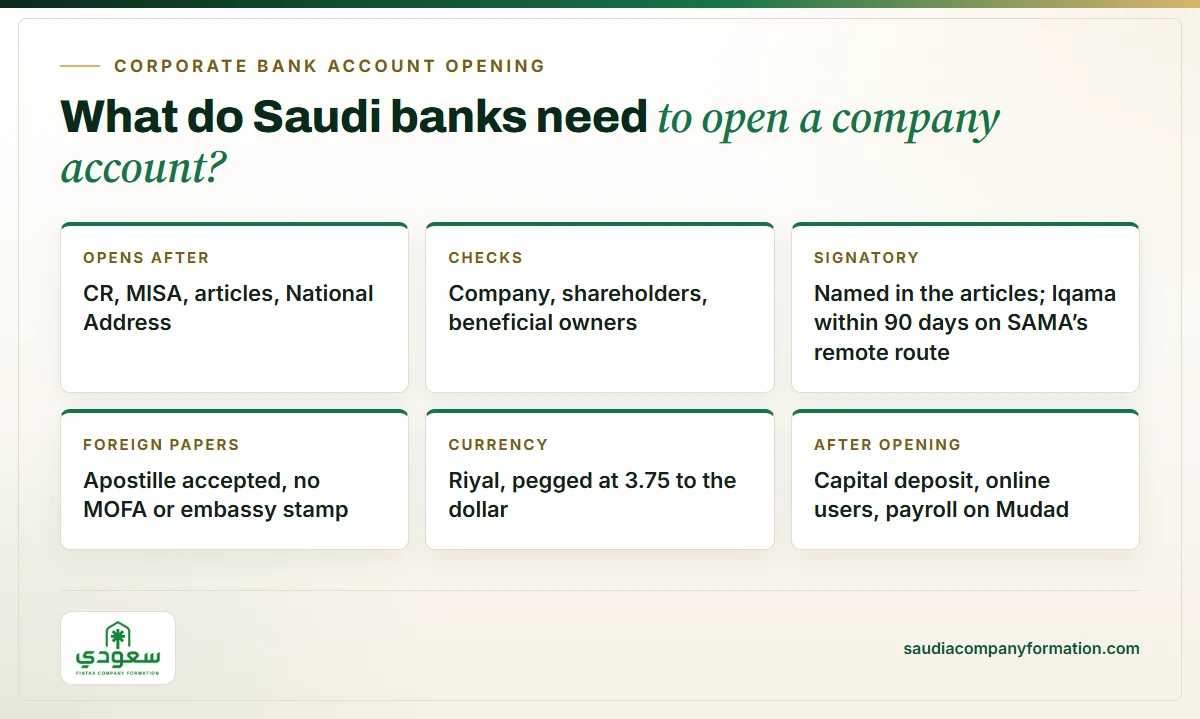
A Saudi bank opens a corporate account once the company exists and checks out: a current CR (Sijil Tijari) and MISA registration, articles that give named people clear banking powers, a National Address, usually a ZATCA number, and know-your-customer documents for the shareholders and the individuals who ultimately own and control them.
Then the bank wants to deal with the person who will run the account. Since 2022, SAMA’s rules have let a foreign-invested company’s general manager, named in the articles with banking powers, open the account remotely on a passport, provided an Iqama follows within 90 days of opening. Whether a bank offers that route is its own decision, so ask before anyone books a flight to Riyadh or Jeddah.
Score yourself
Answer these ten questions before you book the bank meeting. Every “no” means a delay, and most take days to fix if you catch them first.
Banks compare them letter by letter, in Arabic and English.
Banks check status online, and under SAMA’s August 2025 circular a bank freezes the account the moment the CR is suspended.
Vague signing powers are the commonest reason files come back.
Each bank decides whether to offer SAMA’s remote route.
On the remote route it is due within 90 days of opening. See investor visa and Iqama.
The Ministry of Commerce’s rules name anyone holding 25% or more, directly or indirectly; a chart down to those individuals answers the bank before it asks.
Apostilled papers from Convention countries need no MOFA or embassy stamp on top; papers from other countries still go through legalisation.
Some banks want evidence of premises.
Many banks ask for the tax number. See ZATCA registration.
Expected customers, transaction types and source of funds, in plain words.
This is what we work through in a readiness review. Requirements differ between banks; the bank you choose has the last word.
Ready or not
Five areas decide how fast a Saudi bank moves on a corporate account: records, the signatory, ownership, documents and the business story. Banks rarely refuse a well-prepared file outright. They ask questions instead, and each question costs days.
Swipe to compare →
| Area | Helps | Delays |
|---|---|---|
| Records | CR, MISA, articles and address all match | Names or activities that differ |
| Signatory | Resident, with clear powers | Non-resident, with vague powers |
| Ownership | Clear chart to individuals | Unexplained holding companies |
| Documents | Recent, apostilled or legalised, translated | Old extracts, missing stamps |
| Business story | Clear activity, customers, funding | Unclear activity or funding |
Order
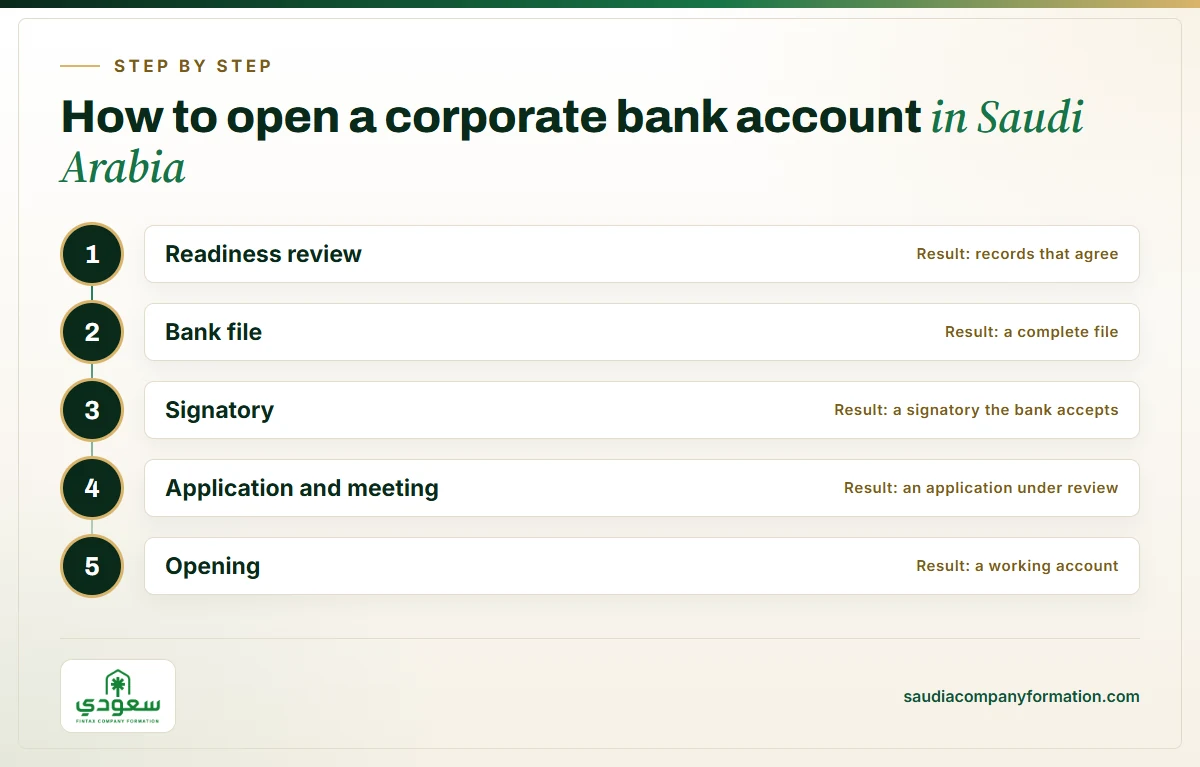
Opening a Saudi corporate account takes five steps, from a readiness review to a working account with payroll set up. The first step is about the company, not the bank. The capital goes in last, after the Commercial Registration and the opening.
CR, MISA, articles, address, tax registration and ownership checked against each other.
Result: records that agree
Documents for the company, its shareholders and the beneficial owners assembled and certified.
Result: a complete file
Signatory and powers confirmed, residency timed to the meeting or to SAMA’s 90-day window.
Result: a signatory the bank accepts
Application submitted, and the meeting prepared: what the company does, the transactions it expects and where its money comes from.
Result: an application under review
Account opened, capital deposited, online users and payroll set up.
Result: a working account
The file
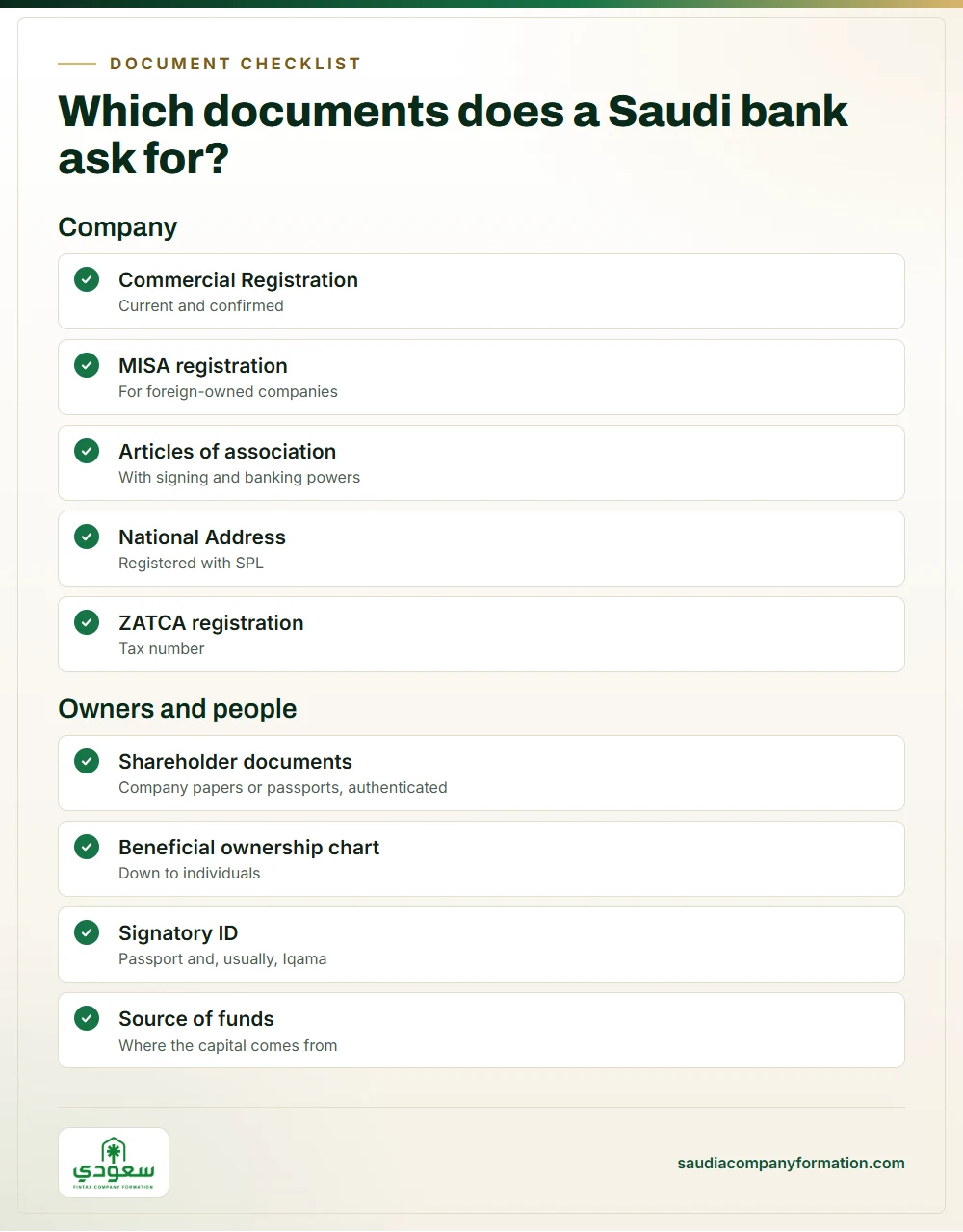
Saudi banks set their own lists, but SAMA’s account-opening rules fix the core: the CR, the articles with annexes, the manager’s ID, the IDs of those authorised to sign, and checks on the owners named in the articles. Since 2023 SAMA no longer requires the foreign partner’s founding documents, though your bank may still ask. Shareholder papers differ by country; see our guides for shareholders in Pakistan, in India and in Bangladesh.
Commercial RegistrationCurrent and confirmed
MISA registrationFor foreign-owned companies
Articles of associationWith signing and banking powers
National AddressRegistered with SPL
ZATCA registrationTax number
Shareholder documentsCompany papers or passports, authenticated
Beneficial ownership chartDown to individuals
Signatory IDPassport and, usually, Iqama
Source of fundsWhere the capital comes from
Client review
Dua e Fatima’s tourism company was formed and then activated with us: bank account, tax registration and visas. Her Google review mentions the bank account first. Other finished files are in our portfolio.
"Got my tourism business established in KSA, they managed my after incorporation tasks too. Helped me open my bank account and get my tax registration and also facilitates my VISA. Happy with their services."
Our part
Our bank-account work has three parts: a readiness review of your records, a complete bank file, and preparation for the signatory’s meeting. The bank makes the decision. This work, for a fixed fee agreed before we start (see how we work), decides how many questions it has to ask first.
RecordsYour company records checked against each other and against what banks ask for, with gaps fixed before applying.

FileEvery company and shareholder document, plus the ownership chart, in one consistent certified set.
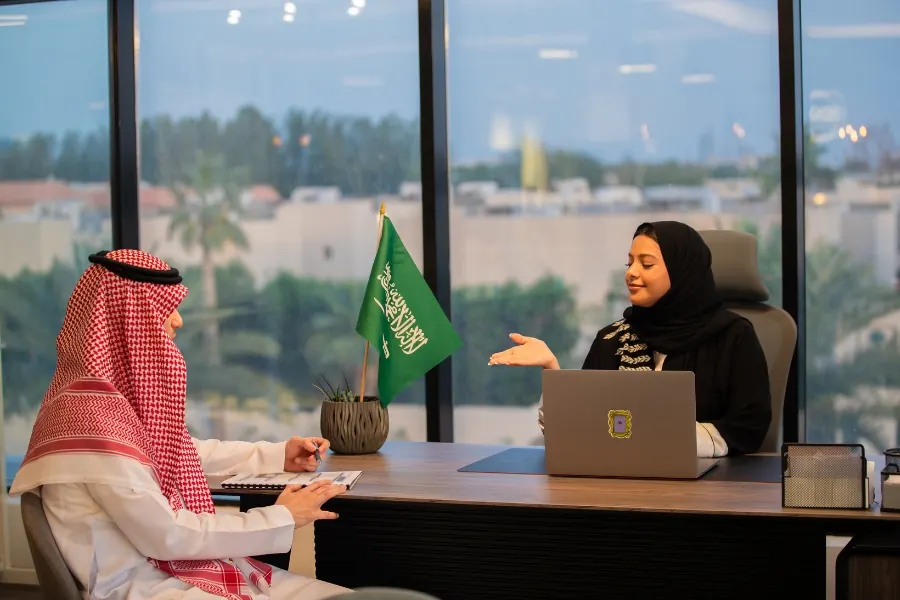
MeetingYour business, expected transactions and source of funds explained the way a relationship manager needs to hear it.
Banking questions · 48
Each bank sets its own rules on top of SAMA’s; these answers reflect SAMA’s Rulebook and common practice as of October 2026.
Yes, once it is registered. Companies and branches open corporate accounts with Saudi banks.
Once the CR and MISA registration are issued, the articles are in place and the National Address is registered. Most banks also want the ZATCA number.
Choose the bank that fits how money will move: a trader using letters of credit needs different services from a consultancy that only invoices. The choice is yours; we prepare the file for it.
No. Banks open accounts for registered companies.
The main account is in riyals, and most banks also offer foreign-currency accounts.
Each bank sets its own minimum balance and charges; we tell you before you choose.
Yes, at 3.75 to the US dollar since 1986.
Yes. Article 6 of the Investment Law Implementing Regulations guarantees the free transfer of profits and dividends. The cost is 5% withholding on dividends to non-residents.
Yes. SAMA’s rules ask for a mandate from head office naming who signs in Saudi Arabia. See branch registration.
Usually the CR, MISA registration, articles, National Address, ZATCA registration, shareholder documents, an ownership chart and the signatory’s ID.
From Apostille Convention countries, an apostille is enough: SAMA’s circular of 24 October 2023 tells banks not to ask for MOFA or embassy authentication on top. Papers from other countries still go through legalisation. See attestation and apostille.
Under the Ministry of Commerce’s Beneficial Ownership Rules (Resolution 99, December 2025): first, any individual owning 25% or more directly or indirectly; failing that, whoever controls the company; failing that, its manager or board.
Yes. They must give the signatory clear authority to open and operate accounts.
Some banks ask for one alongside the National Address.
Yes, source of funds is a standard question.
Some banks require one. Elsewhere, a one-page note on what the company sells, to whom and how money moves still answers the meeting’s questions.
Expect it when a company is a shareholder: the parent’s latest financial statements join the file.
The bank looks through them to the individuals, and in lower-risk cases SAMA lets it finish that check after opening.
Usually the general manager who will run the company in Saudi Arabia.
Yes, with sole or joint authority set in the articles and the bank mandate.
On SAMA’s remote route the general manager starts on a passport and must show an Iqama within 90 days of opening. Beyond that, each bank sets its own policy.
Only if the articles or a resolution give that person banking powers and the bank accepts a non-resident signatory; policies differ between banks.
Through the company: work visa, permit, medical, insurance, Iqama. See investor visa and Iqama.
The articles and CR are updated if needed, then the bank mandate.
SAMA accepts a notarised power of attorney, or an authorisation signed inside the bank, as the basis for signing powers; banks add their own policy.
Not after opening; online banking works from abroad within the bank’s security rules.
Anywhere between a few days and several weeks. The bank sets the pace; a complete file is the part you control.
Usually once, for the signatory, unless your bank offers SAMA’s remote route.
We prepare you, and support you in it where the bank allows; the bank deals with your signatory.
Identity, the business, expected transactions and funding are confirmed, and forms signed.
After the account opens. The Ministry of Commerce’s incorporation flow takes the capital amount without a bank deposit certificate, so the CR comes first and the deposit follows.
Some steps can; most banks keep one in-person step.
We answer quickly; slow replies are where weeks are lost.
By bank transfer, with the wage file uploaded on Mudad for the Wage Protection Program. See GOSI and Qiwa.
Through the bank’s payment services for government bills.
Yes. Dividends to non-resident shareholders carry 5% withholding, and a branch’s profit sent to head office is treated the same way.
Yes, documented; interest paid abroad carries 5% withholding as a loan charge.
Yes, through foreign-currency accounts.
In practice yes: payroll under wage protection and government payments run through Saudi banks.
Yes, through banks and licensed payment providers after their own checks.
Mismatched records, unclear ownership, no resident signatory, old documents, unclear funding.
We find the reasons, fix the records and prepare a new file for the same or another bank.
Yes. Each bank decides independently.
No, but without an account salaries and fees are hard to pay, so act quickly.
Formation errors often surface at the bank; we review the records first.
Not always in detail. Checking the file against the ten questions above points to the likely reasons.
Yes. Under SAMA’s August 2025 circular a bank freezes a company’s accounts as soon as its CR is suspended, which happens 90 days after a missed annual confirmation. Our PRO and compliance service keeps those dates.
No. The bank decides; we make the file as strong as it can be.
References
Opened on 15 October 2026 before citing. Your bank’s own checklist overrides any general guide.
Readiness review
We reply within one working day with what the bank will want to see and the gaps in your current records.
Before the bank
Commercial Registration (CR)Forming the company with the Ministry of Commerce.See Commercial Registration (CR) →

Investor visa and IqamaResidency for owners and general managers.See Investor visa & Iqama →

ZATCA, VAT and e-invoicing registrationZakat, tax, VAT and Fatoora.See ZATCA, VAT & e-invoicing →

PRO and compliance servicesRenewals, filings and government follow-up.See PRO & compliance →From our guides: how to form a company in Saudi Arabia from Pakistan
Setting up from your country: from Pakistan · from India · from Bangladesh