


Saudia Company Formation
Waterfront development in Saudi Arabia

Licences · Wholesale, retail and e-commerce

Trading license in Saudi Arabia, and the lighter routes to test the market first.

Foreign investors can own a Saudi trading company outright, but MISA asks a lot for it: SAR 30 million in capital, an existing presence in three markets, and a commitment to invest at least SAR 300 million over five years. A Saudi partner holding 25% brings the capital down to SAR 26,666,667, and a distributor needs no Saudi company at all. We set out each route with MISA’s figures, then build the one you choose.

  • Route choice
  • Wholesale
  • Retail
  • E-commerce
  • MISA conditions
  • CR
  • Importer registration
  • HS codes
  • SABER
  • SFDA
  • VAT

Start here

Four ways a foreign brand can sell in Saudi Arabia

A foreign brand can sell in Saudi Arabia through its own trading company, a company shared with a Saudi partner, a Saudi distributor, or direct from abroad, and only the first two need a trading licence. The right route depends on your Saudi volumes and how much control you need over pricing and stock.

Routes for a foreign business to sell goods in Saudi Arabia
Question100% foreign trading companyTrading company with a Saudi partnerSaudi distributor or agentSelling from abroad
Capital in Saudi ArabiaSAR 30 millionSAR 26,666,667None of yoursNone
Who owns the businessYou, 100%You and a Saudi partner (25%+)The distributorYour foreign company
CommitmentsSAR 300M invested over five years, or SAR 200M plus a local targetPer MISA’s conditionsWhatever the contract saysVAT registration if you supply in KSA
Control of pricing and stockFullSharedLimitedLimited by logistics
SuitsLarge brands already regionalPartners who trust each otherTesting demandOnline sellers starting out

Our usual advice: start with a distributor or a partner, measure demand, then buy control. Committing SAR 30 million before you know your Saudi volumes is rarely the right first move.

The rules

What does a trading license require from a foreign investor?

A trading license in Saudi Arabia means a company registered with MISA and the Ministry of Commerce for wholesale, retail or e-commerce, plus importer registration if it brings in goods. MISA treats this commercial activity as a special category with its own capital and investment conditions.

Those conditions are on the right. They apply to 100% foreign ownership; a Saudi partner with at least 25% changes the capital figure but not the need to plan. The MISA registration comes first, and the Commercial Registration must then list the same trading activity.

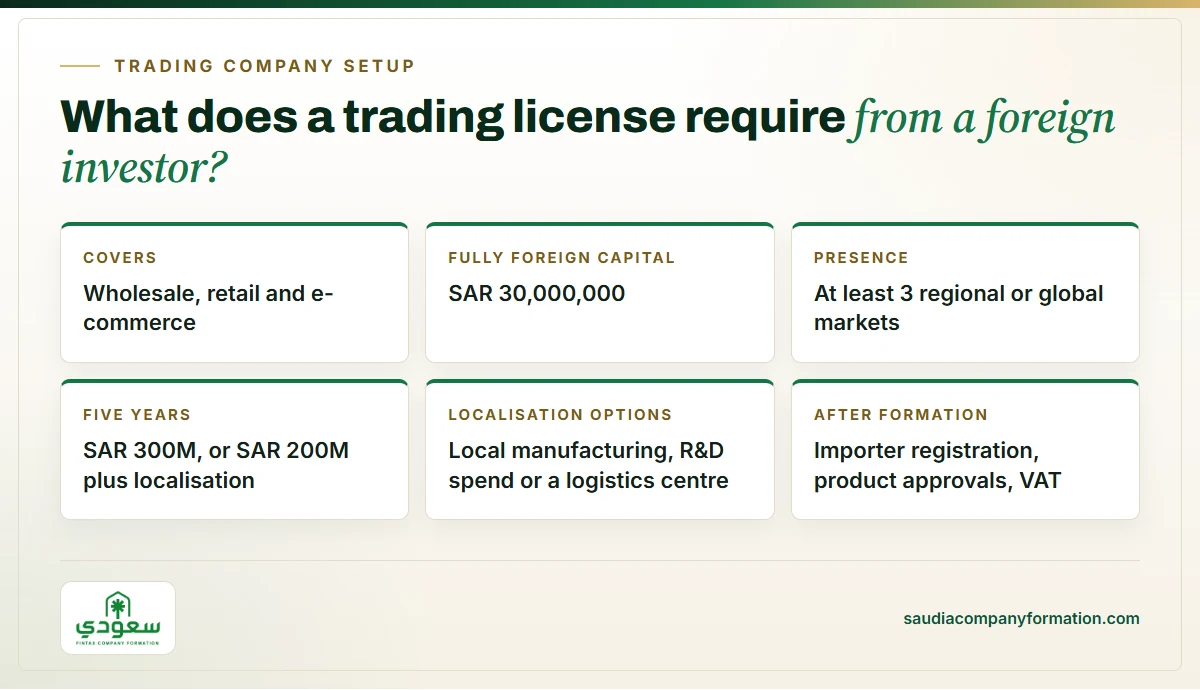
Infographic: trading licence facts for foreign investors in Saudi Arabia
MISA’s conditions on one page.
Covers
Wholesale, retail and e-commerce
Fully foreign capital
SAR 30,000,000
Presence
At least 3 regional or global markets
Five years
SAR 300M, or SAR 200M plus localisation
Localisation options
Local manufacturing, R&D spend or a logistics centre
After formation
Importer registration, product approvals, VAT

Commitments

What the five-year commitment actually asks

A 100% foreign trading company commits to invest SAR 300 million over five years, or SAR 200 million plus one localisation commitment, under section 5.1.3 of MISA’s Investor Guide (13th edition, 2026). Saudi hiring and training targets run alongside the money.

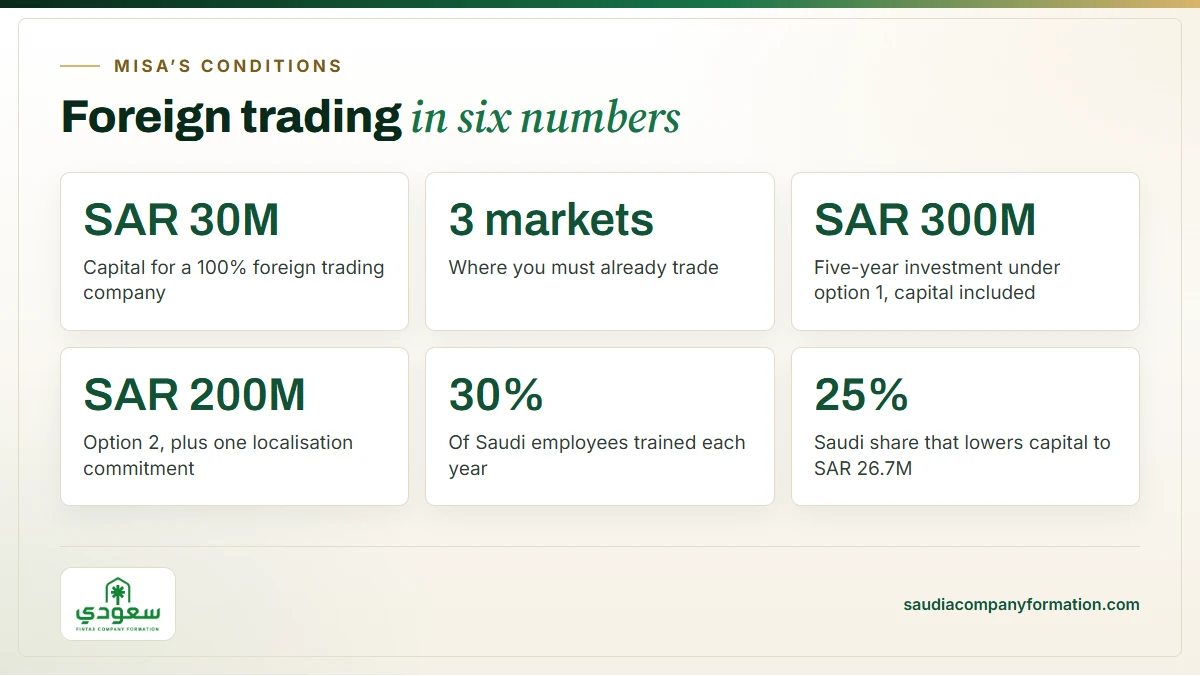
Infographic: MISA capital and investment conditions for trading companies
MISA’s commercial-activity conditions in numbers.

Two investment options

Option 1: invest at least SAR 300 million over five years from registration, including SAR 30 million as the company’s cash capital.

Option 2: invest at least SAR 200 million, including the same SAR 30 million, and meet one more requirement within five years: manufacture 30% of the products you distribute locally in Saudi Arabia, spend 5% of sales on local R&D, or build a unified logistics and after-sales centre.

Team planning Saudi hiring and training
The staffing obligations run alongside the investment.

Saudi staff and training

The company meets the Saudization rates set by the Ministry of Human Resources, plans to bring Saudis into senior management within five years, and trains 30% of its Saudi employees every year.

None of this is unreasonable for a large brand. It is a lot for a business that has never sold a unit in the Kingdom, which is why the route comparison comes first. Hiring details are on our GOSI and Qiwa page.

Before the first container

Eight checks before your first shipment lands

A first shipment into Saudi Arabia clears customs only when the company’s activities, its ZATCA importer registration and each product’s approvals are already in place. Most held shipments fail on one of these eight checks, so we run the list with you for every product line.

  1. Is the company registered for the exact trading activity?

    Importing goods to resell needs a trading activity on both the MISA registration and the CR.

  2. Is the company registered as an importer with ZATCA?

    ZATCA runs customs. Importers register on its FASAH platform with the CR number, and without that account nothing clears.

  3. Does each product have the right HS code?

    The tariff code drives the duty rate and which approvals apply, so a wrong code sends the goods down the wrong checks.

  4. Does the product need a SABER certificate?

    Many regulated consumer and industrial goods need a product certificate and a shipment certificate on SASO’s SABER platform before clearance.

  5. Is it food, cosmetics, a medical device or a medicine?

    Those fall under SFDA, which decides whether each product needs registration, a listing or only a licensed importer.

  6. Does the label need Arabic?

    Many regulated products must be labelled in Arabic under SASO or SFDA rules.

  7. Is VAT registration in place or planned?

    VAT at 15% applies on import. Registration is mandatory once taxable supplies pass SAR 375,000 in 12 months.

  8. Is there a warehouse or logistics partner?

    Wholesale needs storage, and a third-party logistics provider can hold stock without a lease of your own.

Product approvals differ line by line, so we map them before you place orders, not after the goods have shipped.

How we help

Three ways to get started

We start trading clients in one of three ways: a route assessment, a full trading company setup, or importer set-up for a Saudi company already licensed to trade. Take the assessment first if you are not sure which route fits; it is credited if you go on to the setup.

Start here

Assessment

Trading route assessment

The four routes compared against your own volumes and the capital you can commit, ending in our recommendation in writing.

  • Your channels and volumesReviewed
  • RoutesCompared
  • MISA conditionsExplained
  • RecommendationWritten

For brands still deciding.

Quote the assessment
Full setup

Company

Trading company setup

MISA and the CR under the route you chose, then importer registration and a product approvals plan, with VAT and banking live before the first sale.

  • RouteConfirmed
  • MISA and CRIssued
  • Importer and customsBefore shipment
  • VAT, Fatoora, bankLive

For brands ready to commit.

Quote the setup
Import only

Existing company

Importer and customs set-up

For a Saudi company already licensed to trade: importer registration, approvals map and VAT readiness.

  • Importer registrationZATCA
  • Approvals mapPer product
  • VAT and e-invoicingReady
  • PaymentsSet up

For licensed companies importing for the first time.

Quote import set-up

Sequence

How to set up a trading company in Saudi Arabia

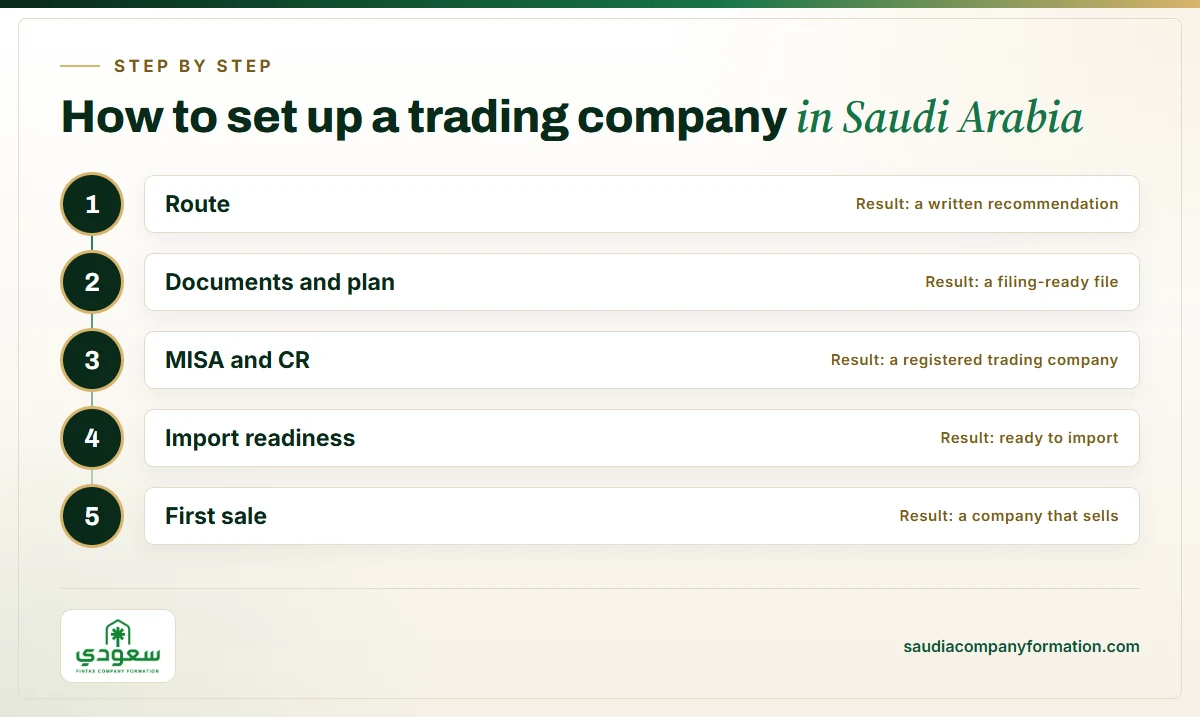
Setting up a trading company in Saudi Arabia runs in five stages, from the route decision to the first correctly invoiced sale. The route comes first because it decides how much capital you need and which documents MISA will ask for.

  1. Step 01

    Route

    Your sales channels and expected Saudi volumes matched to one of the four routes.

    Result: a written recommendation

  2. Step 02

    Documents and plan

    Group papers and proof of three-market presence authenticated, and the five-year investment commitment costed for the option you choose.

    Result: a filing-ready file

  3. Step 03

    MISA and CR

    MISA registration under the commercial-activity conditions, then the articles of association and the CR.

    Result: a registered trading company

  4. Step 04

    Import readiness

    Importer registration with ZATCA, an HS code for each product, the SABER or SFDA approvals each line needs, and logistics.

    Result: ready to import

  5. Step 05

    First sale

    VAT and e-invoicing live, bank open, first invoices correct.

    Result: a company that sells

Infographic: the stages of setting up a trading company in Saudi Arabia
From route choice to the first cleared shipment.
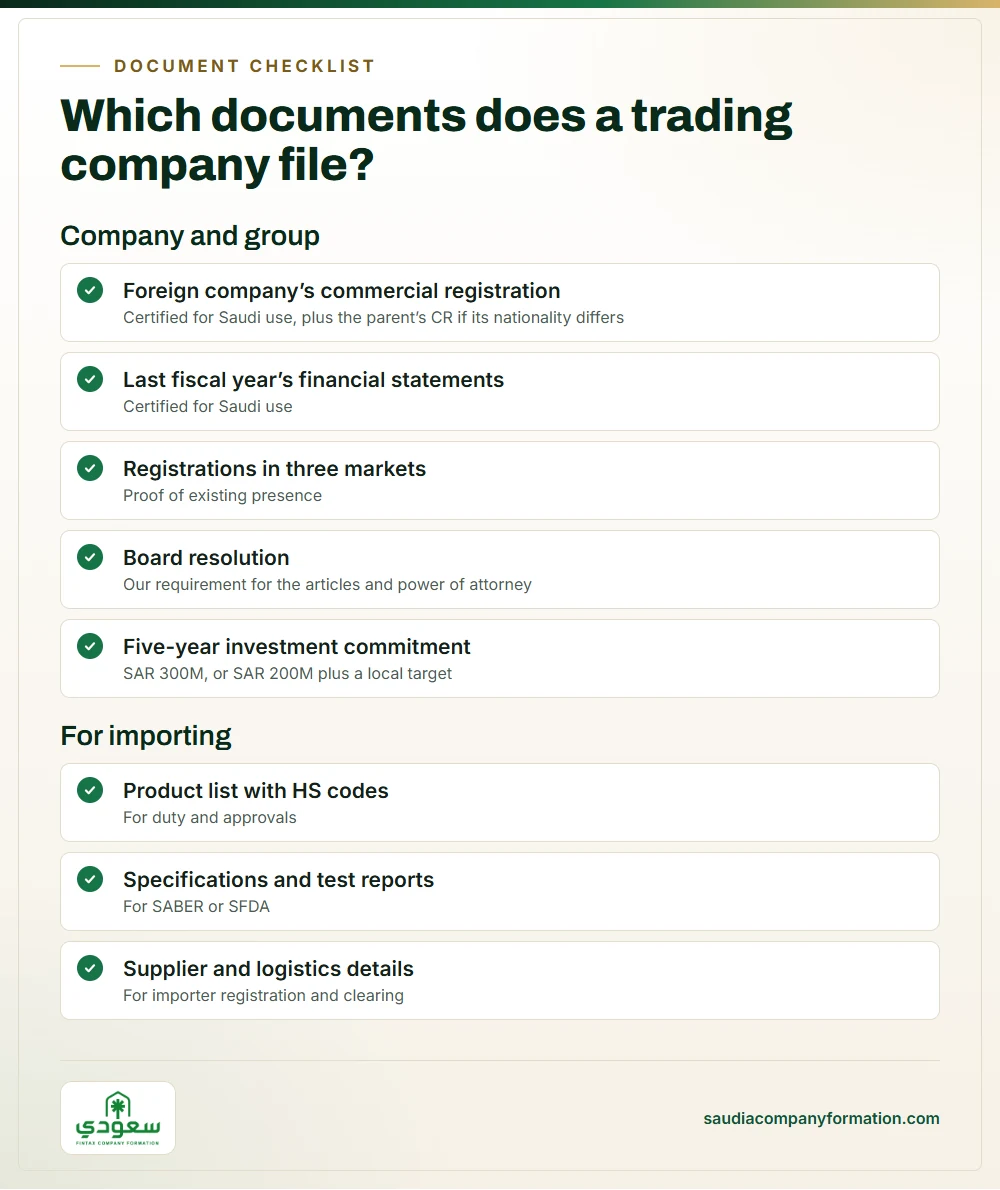
Infographic: documents for a foreign-owned trading company
Trading files add proof of presence elsewhere.

Paperwork

Which documents does a trading company file?

A 100% foreign trading company files the standard MISA company papers plus proof that it already trades in at least three regional or global markets. Importing adds a product list with HS codes and the test reports behind each approval.

Company and group

  • 01

    Foreign company’s commercial registrationCertified for Saudi use, plus the parent’s CR if its nationality differs

  • 02

    Last fiscal year’s financial statementsCertified for Saudi use

  • 03

    Registrations in three marketsProof of existing presence

  • 04

    Board resolutionOur requirement for the articles and power of attorney

  • 05

    Five-year investment commitmentSAR 300M, or SAR 200M plus a local target

For importing

  • 01

    Product list with HS codesFor duty and approvals

  • 02

    Specifications and test reportsFor SABER or SFDA

  • 03

    Supplier and logistics detailsFor importer registration and clearing

Money

What decides the cost of a Saudi trading company

The route decides the cost of a Saudi trading company more than anything else: with 100% foreign ownership, MISA’s capital and five-year investment conditions outweigh every set-up fee combined. On the other routes, the number of group documents to authenticate and the product approvals drive it. Our own part is a fixed fee for the agreed scope.

  • Capital and five-year investmentPer MISA’s conditions
  • MISA, CR and customs registrationSaudi government
  • Legalisation of group documentsSeveral countries
  • Product certificatesPer product line
  • Our feeFixed

Trading questions · 50

Questions about trading in Saudi Arabia

Fifty answers drawn from MISA’s Investor Guide (13th edition, 2026) and ZATCA guidance. Anything specific to your products, we confirm in writing.

01The licence

Can a foreigner get a trading licence in Saudi Arabia?

Yes. MISA opens wholesale and retail trading, online sales included, to foreign investors under its commercial-activity conditions.

What counts as a trading licence?

A company registered with MISA and the Ministry of Commerce for trading activities, plus importer registration if it imports.

Is e-commerce trading?

Yes. Selling goods online is commercial activity under the same conditions.

Can a services company import goods to resell?

Only if trading is among its registered activities on both MISA and the CR.

Do manufacturers need a trading licence to sell their own goods?

A licensed manufacturer sells its own products. The trading conditions target companies whose business is buying and selling.

Which authorities regulate trading?

MISA and the Ministry of Commerce register the company. ZATCA runs customs and VAT, while SASO and SFDA set the product rules.

Is a commercial agency the same as a trading licence?

No. An agency is a registered contract with a Saudi agent; a trading licence means a Saudi company of your own.

Can a trading company also sell services?

Yes, if the services are registered activities open to foreign investment on the same MISA registration and CR.

How long does a trading setup take?

Longer than a service company, because of the extra documents and plan. MISA estimates ten working days once the file is complete.

02Capital and commitments

What capital does a 100% foreign trading company need?

SAR 30 million, according to MISA’s Investor Guide.

What does presence in three markets mean?

That the company already trades in at least three regional or global markets, shown through registrations there.

What are the two investment options?

SAR 300 million over five years, or SAR 200 million plus one localisation commitment, both including SAR 30 million of cash capital.

What are the localisation commitments?

Manufacturing 30% of locally distributed products in Saudi Arabia, spending 5% of sales on local R&D, or a unified logistics and after-sales centre.

When do the five years start?

From the date of the investment registration.

What Saudization obligations come with it?

Ministry of Human Resources rates, Saudis in senior management within five years, and 30% of Saudi staff trained each year.

What if the commitments aren’t met?

The registration’s conditions are breached, with consequences under MISA’s rules. Commit only to a plan you can deliver.

How much capital with a Saudi partner?

SAR 26,666,667, with the Saudi partner holding at least 25%.

03Cheaper routes

How can a small brand sell in Saudi Arabia?

Through a Saudi distributor or agent, or online from abroad with VAT registration.

How does a distribution deal work?

A Saudi company buys and resells your goods. Commercial agency agreements are registered with the Ministry of Commerce.

Can we support our distributor with our own people?

Yes. MISA registers a scientific and technical office for a foreign company that has a Saudi agent or distributor. The office supports them and studies the market, but it cannot sign contracts or trade.

Do foreign online sellers pay Saudi VAT?

Yes. A non-resident making taxable supplies in Saudi Arabia registers for VAT with no threshold, usually through a tax representative.

Can our services LLC add trading later?

Yes, by MISA amendment, provided the commercial conditions are met then.

Are special economic zones an option?

They suit some logistics and manufacturing models with their own rules. We check whether yours fits.

Can a distributor hold stock for us?

Yes, under the distribution contract. It should say who owns the stock until it sells, when you get paid and how returns work.

Which route do you recommend first?

A distributor or a Saudi partner, then full ownership once your Saudi volumes justify SAR 30 million of capital.

04Customs and products

How does a company register as an importer?

On ZATCA’s FASAH platform, using the CR number. Clearance itself goes through a licensed customs broker.

What is SABER?

SASO’s online conformity platform. A regulated product needs a product certificate there, then a shipment certificate for each consignment before clearance.

Which goods need SFDA approval?

Food, cosmetics, medicines and medical devices. SFDA also classifies borderline products, such as a cream that might count as a cosmetic or a medicine.

Is duty charged on imports?

Customs duty depends on the product’s tariff line, and VAT at 15% applies on top.

Which mistakes hold shipments at Saudi customs?

Missing or mismatched certificates, wrong HS codes, and documents that don’t match the invoice.

Who pays duty and import VAT?

The importer of record: your Saudi company, or your distributor if it imports.

Do labels need Arabic?

Many regulated products do, under SASO or SFDA rules.

Do we need our own warehouse?

No. A third-party logistics provider can store and fulfil orders for you.

Does the E-Commerce Law apply to us?

If you sell online to Saudi consumers, yes. It sets duties on disclosure and consumer protection, and on keeping records.

05Tax for traders

What tax does a trading company pay?

20% income tax on the foreign share of profit, zakat on any Saudi or GCC share, and VAT at 15%.

When must a trader register for VAT?

Above SAR 375,000 of taxable supplies in 12 months, voluntarily from SAR 187,500. Most traders cross it quickly.

Can import VAT be recovered?

Yes. A VAT-registered importer reclaims it through its VAT return when the goods are used for taxable sales.

How often do traders file VAT returns?

Monthly above SAR 40 million of annual taxable supplies, quarterly below.

Does e-invoicing apply to traders?

Yes, to every VAT-registered business, with phase 2 integration by revenue wave.

Is there excise tax on some goods?

Yes, on goods such as tobacco and sweetened drinks.

Are exports from Saudi Arabia VAT-free?

Exports of goods can be zero-rated when ZATCA’s conditions and evidence rules are met.

Who files a trading company’s returns?

Its accountant, working from the registrations we set up. See ZATCA and VAT.

06Getting set up

What documents does MISA want for a trading company?

The foreign company’s registration and last year’s accounts, certified, plus proof of three-market presence. A parent company of a different nationality adds its own CR.

Do the documents need an apostille?

From Convention countries, yes; otherwise embassy legalisation. See attestation and apostille.

Can the setup be done remotely?

The registrations can, under power of attorney. Banking and senior hires usually mean a visit.

What follows the CR for a trader?

Importer registration and product approvals come first for a trader, then VAT with e-invoicing, staff registration on GOSI and Qiwa, and the bank account.

Do we need a Saudi bank account to import?

In practice, yes. Customs duty and import VAT are paid from it, and so are your suppliers. See corporate bank accounts.

Can you help with product approvals?

We map the approvals for each product line and coordinate with the specialists who file them.

Do you source products or arrange freight?

No. We handle the company and its registrations and compliance; sourcing and freight stay with you.

Can you take over a stalled trading setup?

Yes. We review what was filed and quote to finish it. The registrations around it are on our company formation services page.

References

What we relied on

Opened before quoting, on 15 October 2026. Product rules change often; SASO and SFDA are the final word on your goods.

Ministry of Investment (MISA)Investor Guide, 13th edition (2026), sections 5.1.1 and 5.1.3misa.gov.sa ↗
ZATCARegister as an importer or exporter (FASAH)zatca.gov.sa ↗
SASO SABERProduct conformity certificatessaber.sa ↗
Saudi Food and Drug AuthorityRegulated product approvalssfda.gov.sa ↗
Saudi Ministry of CommerceCommercial Registration and agenciesmc.gov.sa ↗

Route assessment

Tell us what you sell and where you sell it now

We reply within one working day with the routes open to you and a fixed fee for the assessment or the setup.

  • Four routes compared with real numbers
  • MISA’s conditions explained
  • Product approvals mapped
  • Fixed fees

Your Saudi trading plan

Fields marked with an asterisk are required.

1. About you
Please enter your name.
Please enter an email address, for example yourname@gmail.com.
Please enter a phone or WhatsApp number (at least 7 digits).
2. Your products
Please answer in a few words.
Reply within a working day · Product list welcome