

GOSISocial insurance registration
The employer account opened and each employee added on the right wage and rate.

Documents and people · Employer set-up
Three platforms decide whether a Saudi company can employ anyone. GOSI collects social insurance, Qiwa holds the labour file and work permits, and Muqeem manages foreign staff residency. Set them up in the wrong order, or with wages that don’t match, and hiring stalls. We open them in the order each depends on, and before you make a hire we tell you which GOSI rate and levy it brings.
Written by the formation desk at Saudia Company Formation, Lahore. Contribution rates checked against GOSI’s guide to the new Social Insurance Law and the law text on gosi.gov.sa, wage protection against the Ministry of Human Resources, on 15 October 2026.
Reply within one working day
2% of salaryEmployer GOSI rate for foreign staff
Three platformsGOSI, Qiwa, Muqeem
3 July 2024New law for first-time Saudi contributors
Fixed feeAgreed scope, no hidden costs
Basics
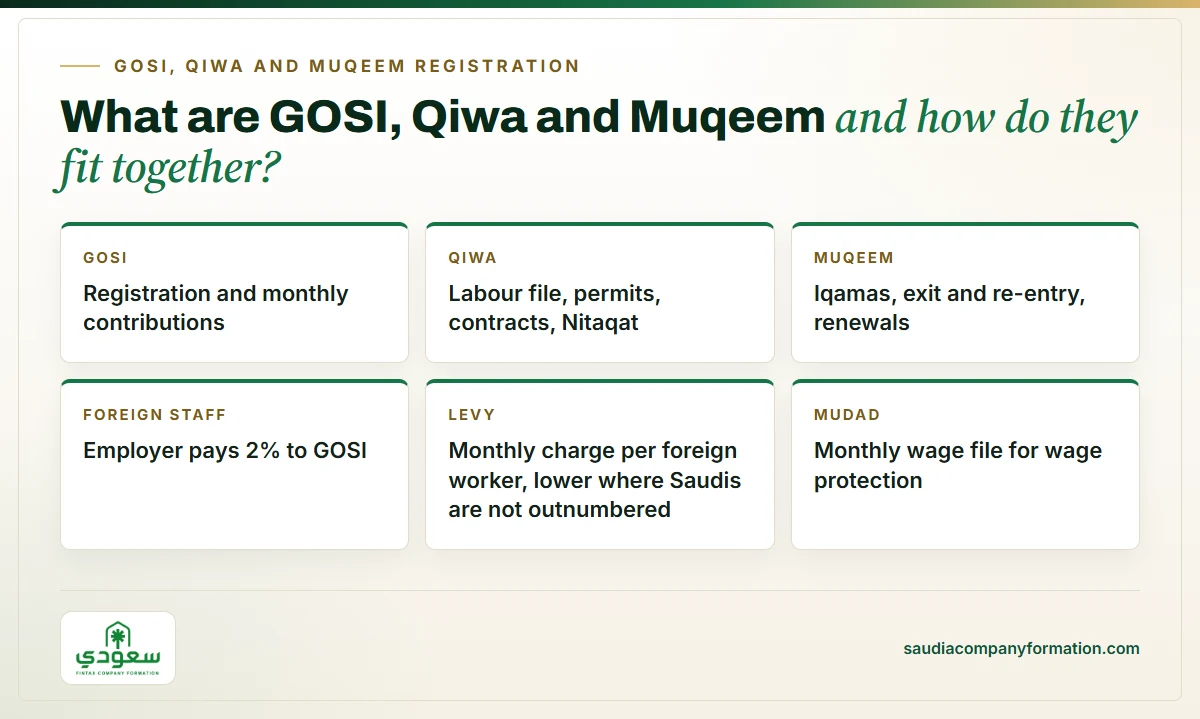
GOSI, Qiwa and Muqeem are the three government platforms a Saudi employer runs its staff through: GOSI (General Organization for Social Insurance) for monthly contributions, Qiwa (Ministry of Human Resources and Social Development) for work permits and contracts, plus the company’s Nitaqat (Saudization) band, and Muqeem (General Directorate of Passports) for foreign employees’ Iqamas and travel visas.
All three hang off the Commercial Registration, and each checks the others. The classic cause of blocked services is a wage on a Qiwa contract that differs from the wage on GOSI. It rarely shows at registration. It shows months later, when a permit renewal or a transfer is refused.
Salaries then run through a fourth platform, Mudad, where the employer uploads its wage file for the Ministry’s Wage Protection Program. The Ministry says the programme has reached every size of firm, down to establishments with one to five staff, since 2020.
Rates per hire
A Saudi employer pays GOSI a percentage of each employee’s contributory wage (basic salary plus housing allowance, capped at SAR 45,000 a month): 2% for a foreign employee, and 11.75% or 12.75% for a Saudi, depending on whether that person contributed before 3 July 2024. Each foreign worker also carries a monthly levy.
Swipe to see the full table →
| Employee | Employer pays to GOSI | Deducted from the employee | Foreign worker levy | What it is charged on |
|---|---|---|---|---|
| Foreign employee | 2% (occupational hazards) | Nothing | Yes, a fixed monthly amount, lower if foreign staff don’t outnumber Saudis | GOSI on the wage; the levy per head |
| Saudi employee who contributed before 3 July 2024 | 11.75% (9% pension, 2% hazards, 0.75% SANED) | 9.75% | None | Contributory wage |
| Saudi employee contributing for the first time from 3 July 2024 | 12.75% from 1 July 2026 (10% pension, 2% hazards, 0.75% SANED) | 10.75% from 1 July 2026 | None | Contributory wage; the pension share rises 0.5 points each July until it reaches 11% in July 2028 |
| Team of 1 Saudi (contributing before July 2024) and 3 foreign staff | 11.75% of the Saudi wage plus 2% of each foreign wage | 9.75% from the Saudi employee | Three levies | Rates on four wages, plus three levies |
The test is the person’s GOSI history, not the hire date: a Saudi who joins you in 2026 but contributed before July 2024 stays on the older rates, so we check each Saudi hire’s record before budgeting. The phase-in comes from GOSI’s guide to the new Social Insurance Law. Add Iqama, work permit and medical insurance on top; those vary by insurer and permit length.
Platforms
Each employer platform sits with a different authority and fails in its own way: unpaid GOSI turns into arrears and fines, a Qiwa problem blocks permits, and a Muqeem gap shows up when a foreign employee needs to travel or renew.
Swipe to compare →
| Question | GOSI | Qiwa | Muqeem |
|---|---|---|---|
| Run by | General Organization for Social Insurance | Ministry of Human Resources and Social Development | General Directorate of Passports |
| Main job | Social insurance contributions | Labour file, permits, contracts, Nitaqat | Foreign staff residency |
| Covers | Saudi and foreign staff | Saudi and foreign staff | Foreign staff |
| When it bites | A 2% monthly fine on unpaid contributions | Blocked permits and services | Travel and renewal problems |
Keep one wage figure for each employee on every platform. A wage that differs between the Qiwa contract and GOSI, or again in the Mudad file, is the mismatch that blocks services later.
Order
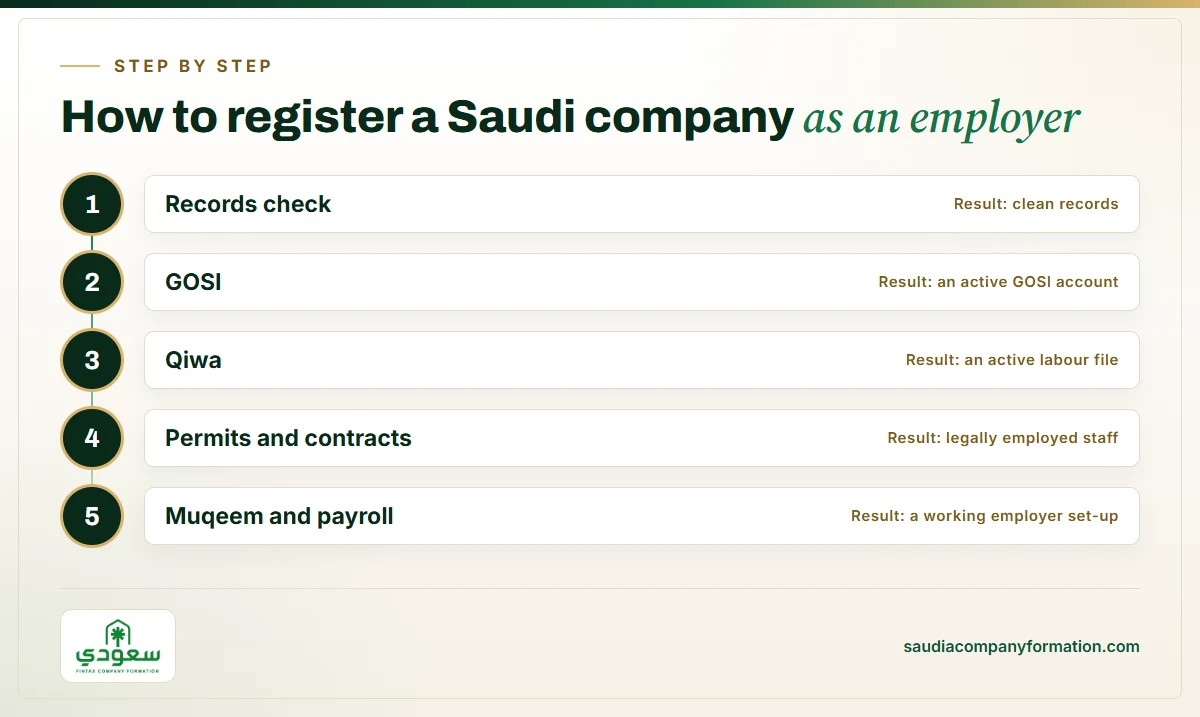
A Saudi company becomes an employer in five steps after the Commercial Registration (Sijil Tijari). The order matters: GOSI and Qiwa read the CR and MISA records, and Muqeem only comes in once foreign staff have permits. In our own formation services this sits after the bank account and ZATCA registration, and before the first work visa and Iqama.
CR and MISA records checked against the National Address registered with SPL; account manager chosen.
Result: clean records
The company registers as an employer.
Result: an active GOSI account
The establishment file is activated and the hiring plan checked against Nitaqat.
Result: an active labour file
Work visas and permits for foreign hires; every contract documented on Qiwa.
Result: legally employed staff
Residency managed in Muqeem, health insurance arranged, payroll set up on Mudad for wage protection.
Result: a working employer set-up
Our part
Our employer set-up registers the company with GOSI, opens the Qiwa labour file, puts permits and contracts in place for foreign hires, and handles their residency on Muqeem. All four run on one wage figure per employee. Where a step needs someone at an office in the Kingdom, our own employee in Saudi Arabia goes; there is no outsourced agent.
GOSIThe employer account opened and each employee added on the right wage and rate.

QiwaThe establishment file activated and your first hires planned so the company starts in a healthy band.

ContractsVisas and permits for foreign hires, and every contract documented to match payroll.

MuqeemIqama issue and renewal for your foreign employees, plus their exit and re-entry visas.
Paperwork
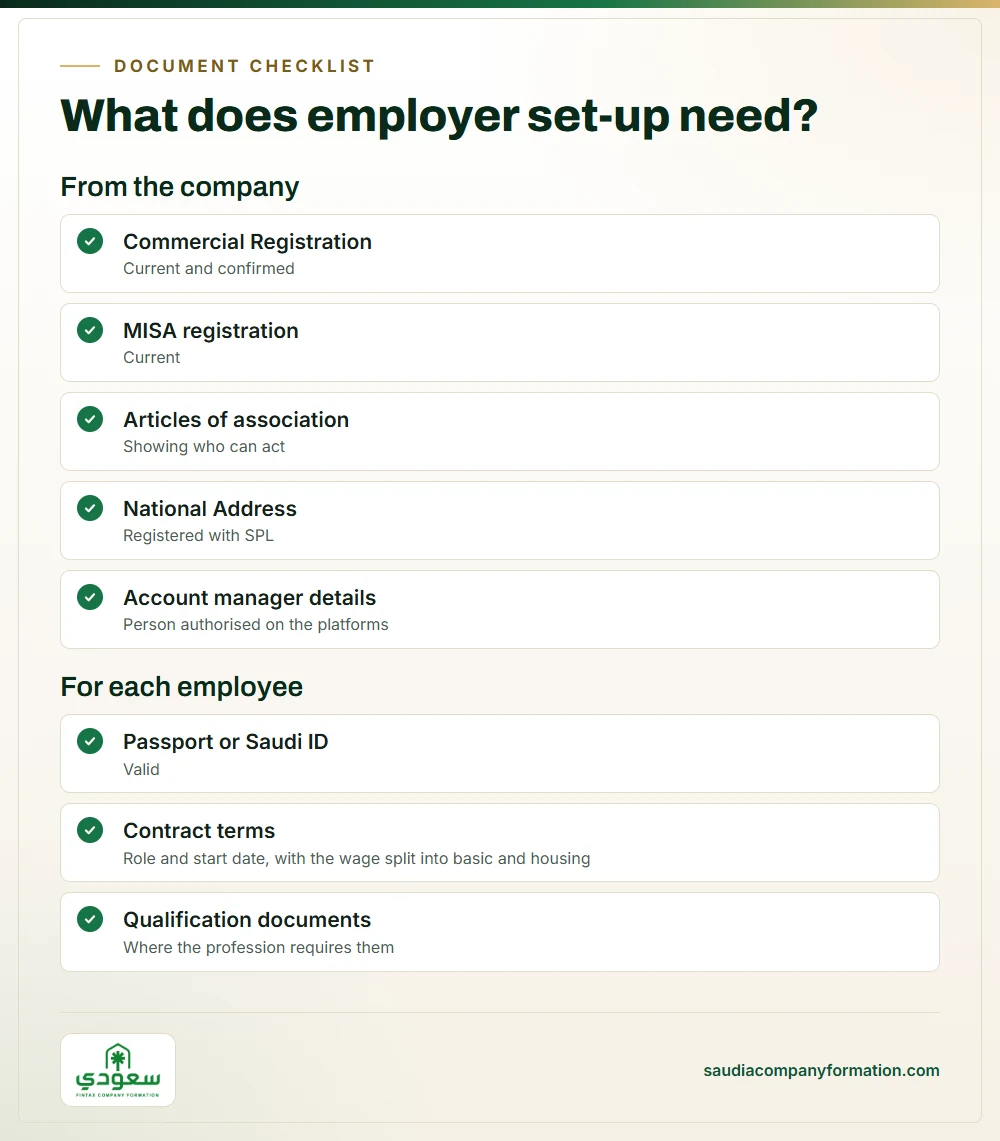
Employer set-up needs four company records (CR, MISA registration, articles of association, National Address) plus a passport or Saudi ID and agreed contract terms for each employee. Most of it you already hold; qualification papers from abroad follow the attestation or apostille route.
Commercial RegistrationCurrent and confirmed
MISA registrationCurrent
Articles of associationShowing who can act
National AddressRegistered with SPL
Account manager detailsPerson authorised on the platforms
Passport or Saudi IDValid
Contract termsRole and start date, with the wage split into basic and housing
Qualification documentsWhere the profession requires them
Budget
A Saudi employer budgets monthly for GOSI and health insurance on every employee, plus the levy and the residency paperwork (work permit, visa, Iqama) for each foreign one. Our set-up fee is fixed for the agreed scope and paid once; how we work explains how the scope is agreed. The rates table above covers GOSI and the levy.
Employer questions · 50
Rates and rules as published in October 2026; we recheck them for your hires.
The General Organization for Social Insurance, which runs social insurance for private-sector employees in Saudi Arabia.
Every employer does, and registers each employee, Saudi or foreign. Occupational hazards cover applies to all workers regardless of nationality.
The employer pays 2% of the contributory wage for occupational hazards. Nothing is deducted from the employee.
For Saudis who contributed before 3 July 2024: 11.75% from the employer and 9.75% from the employee, 21.5% in total. For Saudis contributing for the first time from that date, the rates from 1 July 2026 are 12.75% and 10.75%, 23.5% in total.
A new Social Insurance Law took effect for Saudis with no earlier contribution periods. Their pension rate started at 9% on each side and rises 0.5 points every 1 July from 2025, reaching 11% on each side in July 2028. Saudis who were already contributing stay on the old rates.
The contributory wage: basic salary plus housing allowance, capped at SAR 45,000 a month.
Monthly. Contributions for one month are due within the first 15 days of the next, and the law adds a fine of 2% of the unpaid amount for each month of delay.
Saudi unemployment insurance. Since 1 January 2022 it takes 1.5% of a Saudi employee’s contributory wage, split 0.75% employer and 0.75% employee.
If the owner is employed by the company, for example as general manager, yes.
The Ministry of Human Resources’ platform for the company’s labour file: permits, contracts, transfers and Nitaqat status.
After the CR and MISA registration.
An authorised account manager. MISA’s guide notes some services need a Saudi authorised representative registered as user or account manager.
Get the work visa through Qiwa, bring the employee in, issue the permit and Iqama, document the contract and register them with GOSI. See investor visa and Iqama for the residency side.
A monthly charge for each foreign employee, set per head rather than as a share of salary. The rate is lower where foreign staff don’t outnumber Saudis. The Cabinet has also approved cancelling the levy for foreign workers in licensed industrial establishments, so an industrial licence changes this line.
Yes. The establishment’s Nitaqat band appears on Qiwa under Establishment Assessment, and the band decides which services the company can use.
Yes, documented on Qiwa, matching the GOSI wage.
Yes, by transferring their services through Qiwa with their consent.
Yes, through Qiwa’s occupation change service.
A visa for general manager, CEO or chairman roles, supported by MISA’s services. See investor visa and Iqama.
The Saudization programme that sets targets for Saudi staff by activity and company size and places employers in colour bands, with Red at the bottom.
Yes, from its first hires.
Services such as new work visas and transfers can be restricted.
Yes, certain professions and activities are localised. We check your roles.
Yes. See regional headquarters.
A 100% foreign trading company trains 30% of its Saudi staff each year. See trading licence.
Not always. Nitaqat has rules on how different employment types and wages count, which we check for your plan.
By planning the mix of Saudi and foreign hires before the first visa is filed.
To issue and renew foreign employees’ Iqamas and travel visas without visiting a passports office.
Iqama issue and renewal, exit and re-entry visas, final exits and record updates.
The company subscribes and authorises users.
No. Absher is mainly for individuals; Muqeem is the business platform.
No. Companies subscribe to Muqeem, and each transaction carries its own government fee.
A final exit visa is issued and GOSI and Qiwa records closed.
A replacement is issued; a fine can apply.
The employer insures its staff, and foreign employees can’t get an Iqama without the policy.
The Ministry of Human Resources’ Wage Protection Program: employers upload a monthly wage file on the Mudad platform showing each employee’s salary payment.
Yes, generally by bank transfer from the company’s corporate bank account, with the wage file on Mudad.
A payment due when employment ends, based on service length and wage under the Labour Law.
Yes. The Labour Law entitlement applies to foreign and Saudi employees alike.
Yes. The Labour Law sets working hours and overtime pay, and it sets leave entitlements too.
Your HR team or a payroll provider; we handle the government side.
Days to a few weeks once the CR and MISA records are clean.
Records check, GOSI, Qiwa, permits and contracts, then Muqeem and payroll.
Much of it, with authorised users arranged with you. Where a visit is needed, our own employee in Saudi Arabia attends.
We compare the wage, job title and status each platform holds for every employee, then correct the mismatches at the source.
Qiwa and municipal licensing expect suitable premises for staff, so plan them alongside the first hires.
A Saudi company can exist without staff, but banks and most transactions need at least a resident manager.
No. Accurate records and a calendar matter more for a small team. Our PRO and compliance service keeps that calendar if you want it kept for you.
Yes, from visa to Iqama and GOSI.
The general manager, so the company has a resident signatory. See corporate bank accounts for why banks care.
References
Opened on 15 October 2026 before citing. GOSI and the Ministry of Human Resources publish the current figures.
Hiring plan
We reply within one working day with the set-up order for your hires and the GOSI rate and levy each one brings.
Connected services
Commercial Registration (CR)Forming the company with the Ministry of Commerce.See Commercial Registration (CR) →

Document attestation and apostilleHome-country papers made valid in Saudi Arabia.See Attestation & apostille →

Investor visa and IqamaResidency for owners and general managers.See Investor visa & Iqama →
PRO and compliance servicesRenewals, filings and government follow-up.See PRO & compliance →From our guides: how to get business from NEOM as a supplier